
Enliven Designers 28 August 2026
SEO vs GEO: What's the Difference? (Comparison Content)
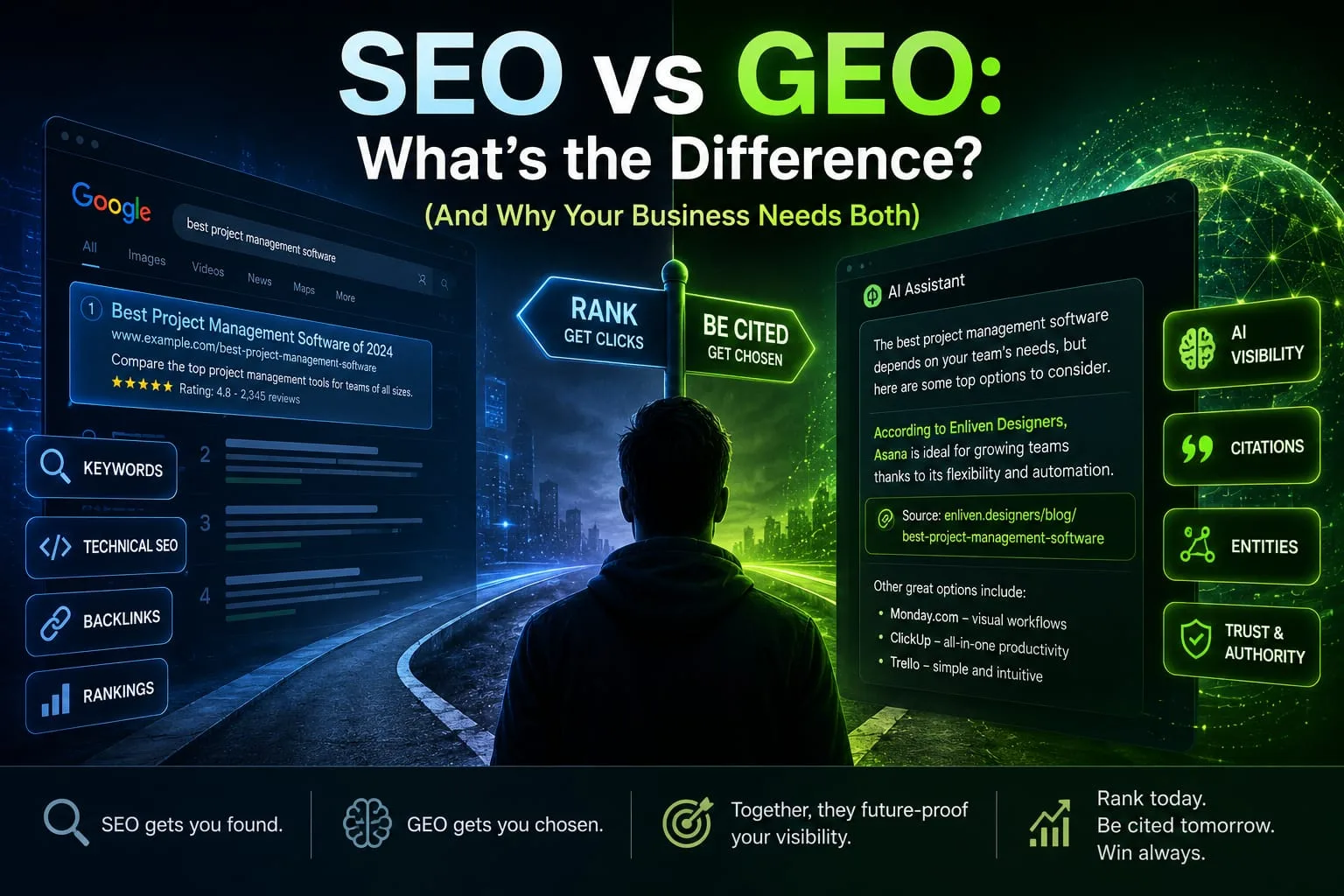
For twenty years, the rules of online visibility fit in one sentence: rank on page one of Google, and customers will find you. Search Engine Optimization (SEO) built an entire industry around that sentence — keyword research, backlinks, meta descriptions, technical audits, content calendars — all pointed at the same target: the blue links on a results page.
That target has started to move.
Ask ChatGPT, Perplexity, Google’s AI Overviews, or Claude a question today, and you won’t get ten blue links — you’ll get an answer, synthesized from multiple sources, often with no click required at all. The source of that answer might be your website. It might be a competitor’s. Increasingly, it might be neither, because the AI simply doesn’t know your brand exists.
This is the gap Generative Engine Optimization (GEO) exists to close. It isn’t a rebrand of SEO — it’s a related but distinct discipline, with its own metrics, its own audit process, and its own tactics. Below, we break down exactly how the two differ, using real deliverables and findings from Enliven Designers’ own GEO engagement work.
The Short Answer
SEO optimizes for search engines that return a list of links for a human to click through. GEO optimizes for generative AI systems that read your content, synthesize it with other sources, and hand the user a finished answer — often without a click at all.
SEO asks: “Will this page rank?”
GEO asks: “Will this brand get cited when an AI answers a question about this topic?”
The two share a foundation — both reward clear, well-structured, authoritative content — but they diverge sharply in how visibility is measured, how content needs to be built, and what “winning” even means. A business can rank #1 organically and still be invisible in every AI-generated answer on its own topic. We’ve seen this firsthand.
What SEO Actually Optimizes For
Traditional SEO is a fairly mechanical pipeline: a search engine crawls a site, indexes its pages, and ranks them against a query using hundreds of signals — backlink authority, page speed, keyword relevance, mobile usability, content freshness. The output is a results page: ten (or fewer) links, competing for a click.
Because the unit of competition is the click, SEO strategy has always revolved around a few core levers:
- Keyword targeting — matching the exact phrasing searchers type into a box.
- On-page optimization — title tags, header structure, internal linking, meta descriptions.
- Technical health — crawlability, indexation, site speed, mobile responsiveness, structured data.
- Backlink authority — earning links from other sites as a trust signal.
- Content freshness and depth — long-form, comprehensive pages that satisfy search intent.
Success is measured in concrete terms: keyword rankings, organic traffic, click-through rate, conversions. It’s a discipline built for a world where the search engine’s job is to point a user somewhere else — and that world still exists. Google isn’t going anywhere. But it’s no longer the whole picture.
What GEO Actually Optimizes For
GEO is the practice of making a brand, its data, and its expertise legible to — and citable by — large language models and AI answer engines. Where SEO optimizes for a ranking algorithm, GEO optimizes for a synthesis process: an AI model reading across many sources, deciding which are trustworthy and relevant enough to draw from, and folding that into a single generated answer.
This changes almost everything about the target:
- There is no fixed results page. The AI’s answer is generated fresh each time, phrased differently every time, and may cite anywhere from zero to a dozen sources.
- Citation, not ranking, is the currency. Being the source an AI model quotes or paraphrases is the GEO equivalent of ranking #1 — except there’s no guaranteed “page one,” and multiple competitors can be cited in the same answer.
- Machine-readability matters as much as human readability. AI systems parse structured data, clear entity definitions, and unambiguous factual statements far more reliably than clever marketing copy.
- Traffic is no longer the only outcome that matters. A user might get their answer entirely inside the AI chat window and never visit the site — yet if the brand was the cited source, it still won influence and trust at the exact moment a buying decision was forming.
Where SEO has two decades of established best practice, GEO is still being defined in real time — which is exactly why running structured audits, building baseline metrics, and testing prompt behavior matters right now.
SEO vs. GEO at a Glance
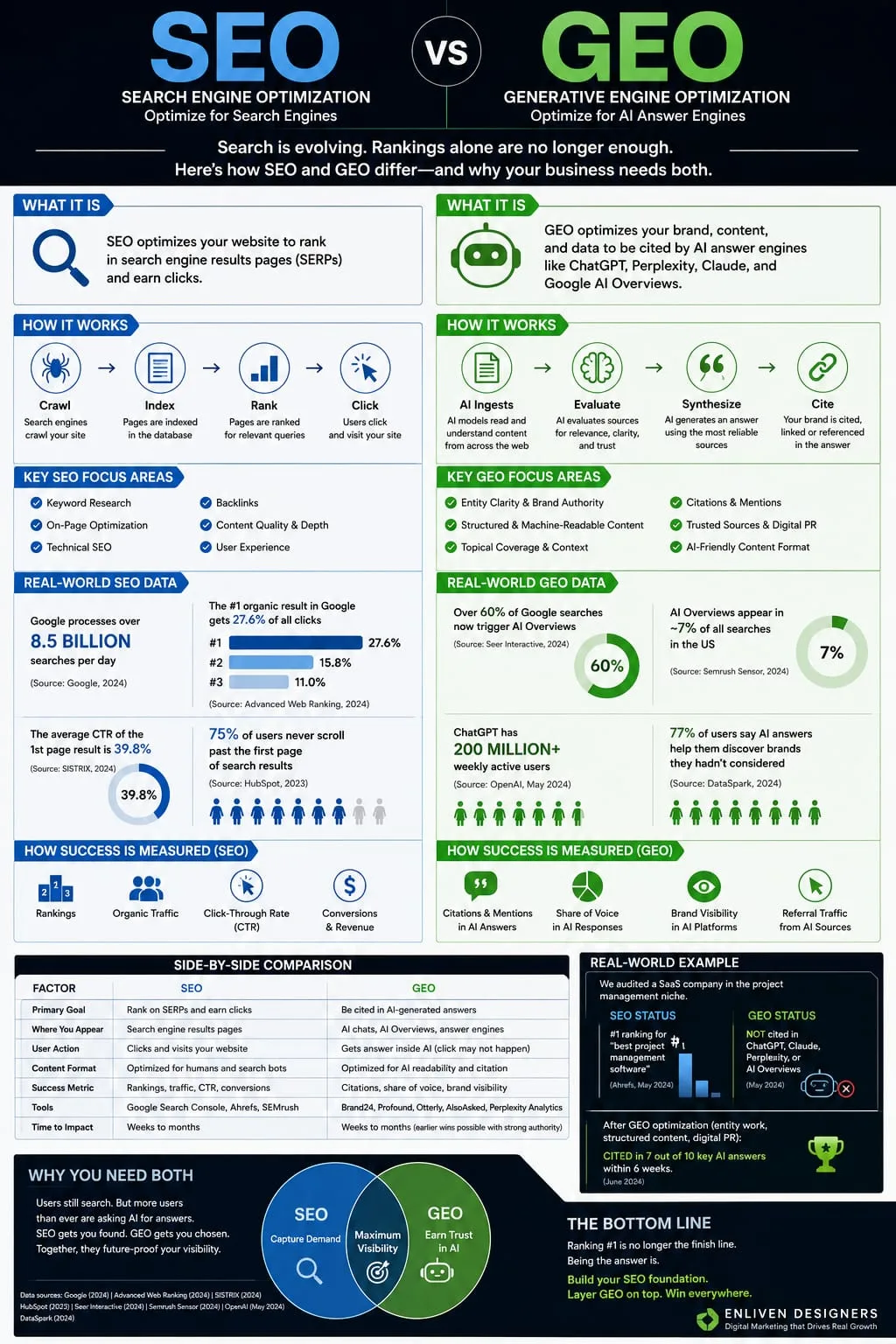
- Goal: SEO ranks a page; GEO earns a citation or mention inside an AI-generated answer.
- Output measured: SEO tracks position on a results page; GEO tracks whether and how often a brand appears in AI responses.
- Content shape: SEO rewards long-form, keyword-rich pages; GEO rewards clear, quotable, fact-dense answers.
- Trust signal: SEO leans on backlinks and domain authority; GEO leans on consistent, factual brand descriptions across many independent sources.
- Competitive landscape: SEO competes for ten blue links; GEO competes for space inside an unlimited, dynamically generated answer.
- Maturity: SEO has 20+ years of established practice; GEO is early and rapidly evolving.
The technical foundations that make a site rankable in Google — clean architecture, fast load times, clear headings, authoritative content — are the same foundations that make it parseable by an AI model. GEO adds a second, more specific layer on top: making sure a brand is unambiguously defined as an entity, that its factual claims are stated in citable form, and that the business understands which prompts AI models are actually being asked about its category. That’s exactly the layer where most businesses have a blind spot — and where we’ve concentrated our GEO engagement work at Enliven.
How This Plays Out in Practice — Enliven Case Studies
Every GEO engagement at Enliven starts with a Phase 1 audit and moves through competitor intelligence, KPI baselining, entity definition, and prompt-level testing. Here’s what each stage actually surfaced on real client work, and what it reveals about the SEO/GEO divide.
1. The Audit That Found a Business Was Invisible to AI Entirely
A Phase 1 audit is a systematic pass through a client’s site and its current AI visibility, mirroring how a technical SEO audit checks crawlability and indexation, but built around how generative engines actually retrieve and cite content.
On one recent audit, this surfaced something a standard SEO checklist might well have caught too, but which had gone unnoticed for months: a noindex, nofollow directive sitting on the client’s homepage. In SEO terms, this is a well-known problem — it tells search engines not to index the page at all. But its implications for GEO were more severe still. If the homepage was invisible to crawlers, it was also invisible to the retrieval systems AI models use to ground their answers in current web content. The business wasn’t just under-optimized — it was structurally excluded from AI visibility at the most fundamental technical level.
This is the kind of issue a GEO audit is specifically designed to catch early, because it explains a symptom that’s otherwise mystifying to a business owner: why does a competitor get mentioned by ChatGPT while this site never does, even though the site looks fine? The answer is very often not a content problem — it’s a technical accessibility problem sitting upstream of everything else. The lesson: GEO and SEO share a technical floor. If an AI system can’t crawl and parse a site, no amount of prompt-level optimization or entity work will matter.
2. Competitor Intelligence Built for a Different Battlefield
A traditional SEO competitive analysis asks: which keywords do competitors rank for that we don’t? A Competitor Intelligence Report built for GEO asks a different question: which topics and questions in this category are AI models already answering, and whose brand gets cited when they do?
That requires probing actual AI outputs across a representative set of category-relevant prompts, tracking which competitor names or claims appear inside generated answers, and identifying where a client’s brand is conspicuously absent from conversations it should logically be part of. In more than one Enliven engagement, the list of “SEO competitors” and the list of “AI-citation competitors” didn’t fully overlap — a business can be a modest player in organic rankings while surprisingly strong (or weak) in AI citation share, and the reverse holds too. Without a GEO-specific competitive lens, a business has no way of knowing which situation it’s actually in.
3. Measuring What SEO Metrics Can’t See
Classic SEO KPIs — organic sessions, average position, click-through rate, domain authority — assume visibility translates into a trackable click. GEO breaks that assumption: a user can get a fully-formed, brand-cited answer inside an AI chat window and never generate a single session on the site.
To close that gap, Enliven’s GEO engagements include a KPI Baseline Dashboard built around metrics designed specifically for AI-native visibility:
- ACR (AI Citation Rate) — how often the brand is cited as a source when AI models answer category-relevant questions.
- QCS (Query Coverage Score) — how broadly the brand appears across the realistic range of questions a customer might ask an AI assistant in the category.
- BIF (Brand Inclusion Frequency) — how often the brand is mentioned even in answers where it isn’t formally cited as a source.
- EAS (Entity Authority Score) — how clearly and consistently an AI system understands what the brand is, what it does, and what it’s known for.
- SAV (Share of AI Voice) — the brand’s citation and mention share relative to direct competitors across the same set of prompts.
None of these existed in a standard SEO reporting stack, because none were needed until AI-generated answers became a real discovery surface. A business might see flat organic traffic while its ACR climbs steadily — a sign that some of its audience shifted discovery channels rather than disappeared. Without a GEO dashboard sitting next to the SEO one, that shift is invisible.
4. Why AI Models Need to Be Told What a Business Is
AI models don’t infer who a business is the way a human reader does. A person landing on an “About” page can piece together, from tone and layout, roughly what a company does. Language models build internal representations of entities based on how clearly and consistently those entities are defined across the content they can retrieve. Marketing copy that reads well to a human can be genuinely ambiguous to a model trying to determine what category a business belongs to and what it’s actually an authority on.
This is what an Entity Definition Document is built to solve — an explicit, unambiguous, machine-legible statement of what a brand is, what it does, who it serves, and what makes it a credible source on its core topics, stripped of the interpretive slack that human-oriented copy relies on. It’s a natural extension of the same principle behind SEO’s structured-data (schema.org) markup, applied more broadly across the brand’s content ecosystem rather than page by page.
5. Learning What AI Models Are Actually Being Asked
SEO keyword research answers a narrow question: what strings of text do people type into a search box? GEO requires a harder version: what do people actually ask an AI assistant, in natural language, when solving a problem in this category — and which of those questions can the brand currently answer well?
To operationalize this, Enliven builds a Prompt Engineering Framework anchored around a 40-prompt AI Visibility Library — a curated, category-specific set of realistic prompts tested directly against live AI models to observe how each one responds: whether the brand is mentioned, how accurately, in what context, and alongside which competitors. This works as both a diagnostic (showing exactly where AI visibility is strong or blank) and a content roadmap (a prioritized, evidence-based list of what content needs to be created, based on observed gaps rather than keyword-volume guesses).
Where SEO and GEO Reinforce Each Other
None of this makes SEO obsolete, and GEO isn’t meant to be pursued in isolation. The homepage indexation issue found in the Phase 1 audit was, at its core, an SEO problem — but fixing it was a prerequisite for any GEO progress, since AI retrieval depends on the same crawlability search engines need. The Entity Definition Document extends a concept SEO has used in schema markup for over a decade. And the content gaps surfaced by prompt testing are frequently gaps a solid SEO content strategy would eventually have found too, just through a slower, keyword-driven route.
A site with strong technical SEO foundations, authoritative content, and clean architecture starts its GEO work from a real head start, because that foundation is exactly what AI systems need to crawl, understand, and cite it. A business that only optimizes for traditional rankings, while ignoring how — or whether — it appears inside AI-generated answers, is optimizing for a shrinking share of how people actually discover businesses today.
What This Means for Your Business
A useful starting exercise: open ChatGPT, Perplexity, or Google’s AI Overview, and ask the exact questions a prospective customer would ask before choosing a business like yours. Does your brand come up? Is it described accurately? Is it cited as a source — or does the answer synthesize information about your category without mentioning you at all, even though you rank well on Google for the same query?
For most businesses that haven’t specifically invested in GEO, the honest answer to at least one of those questions is uncomfortable. That gap — between organic search performance and AI-native visibility — is exactly what a structured GEO audit is built to quantify, and exactly what a technical audit, competitor intelligence, KPI baselining, entity definition, and prompt-level testing are built to close.
SEO built the discoverability infrastructure of the last two decades. GEO is building the discoverability infrastructure of the next one — and the businesses establishing their footing in it now, while most competitors still treat it as a future problem, are the ones most likely to be the cited answer when it matters.
At Enliven Designers, we pair traditional SEO with GEO tracking and content built to be cited, not just ranked — for clients wherever their customers actually are.
Our SEO/GEO Services Include:
- Technical SEO Audits
- Keyword & AI Query Research
- GEO-Structured Content Production
- AI Visibility Tracking (ACR, QCS, BIF, EAS, SAV)
- Competitor Intelligence Reports
- Entity Definition & Prompt Engineering Frameworks
- Local SEO & Google Business Profile Optimization
Contact Enliven Designers today to get a technical audit and see where your brand stands with both search engines and AI assistants.
Frequently Asked Questions
Is GEO just a new name for SEO?
No. They target different systems. SEO optimizes for a ranking algorithm that returns a list of links; GEO optimizes for a language model that synthesizes a single answer and either cites a brand by name or leaves it out entirely. The disciplines overlap in their technical foundations but diverge in what “success” looks like.
Does GEO replace SEO?
No. GEO is additive. AI models still pull from indexed, crawlable web content, so a weak SEO foundation limits GEO results too — as the noindex/nofollow case above shows directly.
Can I measure GEO performance the same way I measure SEO?
Not with the same metrics. Organic sessions and click-through rate can’t capture a citation that never generates a click. GEO needs its own metrics — ACR, QCS, BIF, EAS, and SAV are the ones we track — measured by systematically prompting AI systems and logging how a brand appears.
How long does GEO take to show results?
Less predictable than SEO timelines, mainly because the field is newer and AI platforms update their retrieval and citation behavior frequently. Some businesses see citation improvements within weeks for narrower, less-contested queries; broader category visibility takes longer and requires sustained content and entity-authority work.
How do I check where my brand currently stands?
Ask ChatGPT, Gemini, or Perplexity the questions a customer would ask — “best [service] for [use case]” — and note whether your brand is mentioned, cited, and described accurately. A full audit goes further, checking the technical accessibility issues (like indexation blockers) that often explain an absence before content strategy even enters the picture.