Enliven Designers 24 September 2026
Most businesses find out they have a GEO problem the hard way: a customer mentions that ChatGPT recommended a competitor, or a founder asks Perplexity a question about their own category and doesn’t see their own name anywhere in the answer. By the time that happens, the gap has usually existed for months.
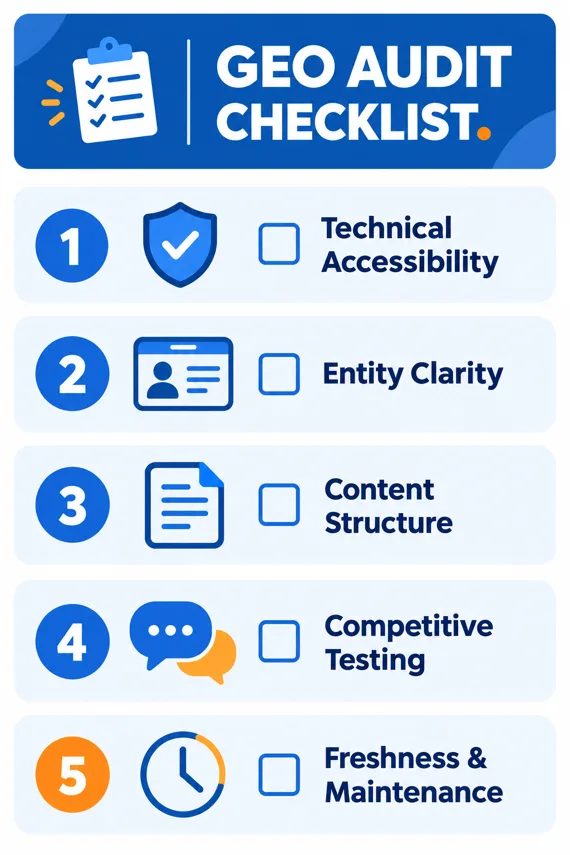
A GEO audit exists to catch that gap early, systematically, before it costs a deal. But “get a GEO audit” is vague advice unless you know what’s actually being checked. Below is the full checklist — the same structure we run through in every Phase 1 GEO Audit at Enliven Designers — broken into five areas: technical accessibility, entity clarity, content structure, competitive and prompt-level testing, and freshness.
This is the floor everything else sits on. If an AI system’s retrieval process can’t crawl and parse your site, no amount of clever content will matter — the brand is invisible at the infrastructure level before visibility is ever a content question.
What to check:
None of this is exotic. It’s the same technical SEO checklist that’s existed for years — but for GEO, the stakes are different. In traditional SEO, a technical issue costs you ranking position. In GEO, it can mean a business simply doesn’t exist as far as an AI model’s retrieval layer is concerned, regardless of how good the content is.
A human visitor can piece together what a business does from tone, layout, and implication. A language model builds its understanding differently — from how clearly and consistently an entity is defined across the content it can retrieve. Marketing copy that reads beautifully to a person can be genuinely ambiguous to a model trying to classify what category a business belongs to.
What to check:
AI systems don’t read a page the way a human skims it top to bottom. They extract discrete, self-contained pieces of information — a definition, a statistic, an answer to a specific question — and recombine them into a synthesized response. Content that’s structured for extraction gets cited more often than content that buries the same information inside dense paragraphs.
What to check:
This is the step most businesses skip entirely, and it’s the one that produces the most actionable findings. A technical and content audit tells you whether a site can be cited. Prompt-level testing tells you whether it actually is being cited, right now, against real competitors, for real questions.
What to check:
This is the layer where a Prompt Engineering Framework and a curated prompt library (Enliven runs a 40-prompt AI Visibility Library across client engagements) earn their keep: a one-off spot check tells you about a moment in time, while a repeatable, documented set of prompts lets you measure whether things are actually improving month over month.
GEO isn’t a project with an end date; it’s closer to a maintenance discipline. Independent tracking of AI citation behavior has found that cited pages have a fairly short “half-life” — often measured in weeks, not months — before newer content starts displacing them in AI-generated answers, even when nothing about the original page has gotten worse.
What to check:
How long does a GEO audit take?
A thorough audit covering all five areas above typically takes one to two weeks, depending on site size and how much prompt-level testing is involved.
Do I need a GEO audit if my SEO is already strong?
Yes. Strong technical SEO is a prerequisite for GEO, not a substitute for it. A site can rank well in Google and still be entirely absent from AI-generated answers, because the two systems weigh different signals.
Can I run this checklist myself?
The technical and content sections are DIY-able with some SEO familiarity. The competitive and prompt-level testing sections benefit from a documented, repeatable prompt library rather than a handful of ad-hoc questions, since consistency is what makes month-over-month tracking meaningful.
What’s the single most common issue this audit finds?
Technical accessibility problems — a stray noindex tag, an overly broad robots.txt rule, or a sitemap that silently stopped updating. These are invisible to a human visitor and easy to miss without specifically checking for them.
At Enliven Designers, this exact checklist is the foundation of our Phase 1 GEO Audit — paired with a Competitor Intelligence Report, KPI Baseline Dashboard, and Entity Definition Document for clients who want to move from diagnosis to a structured improvement plan. Contact us to get a technical and AI-visibility audit for your own site.

Get inspired! See how we've helped businesses like yours achieve success with our diverse portfolio.
Get inspired! See how we've helped businesses like yours achieve success with our diverse portfolio.
Copyright © 2025. All Rights Reserved.