Enliven Designers 5 August 2026
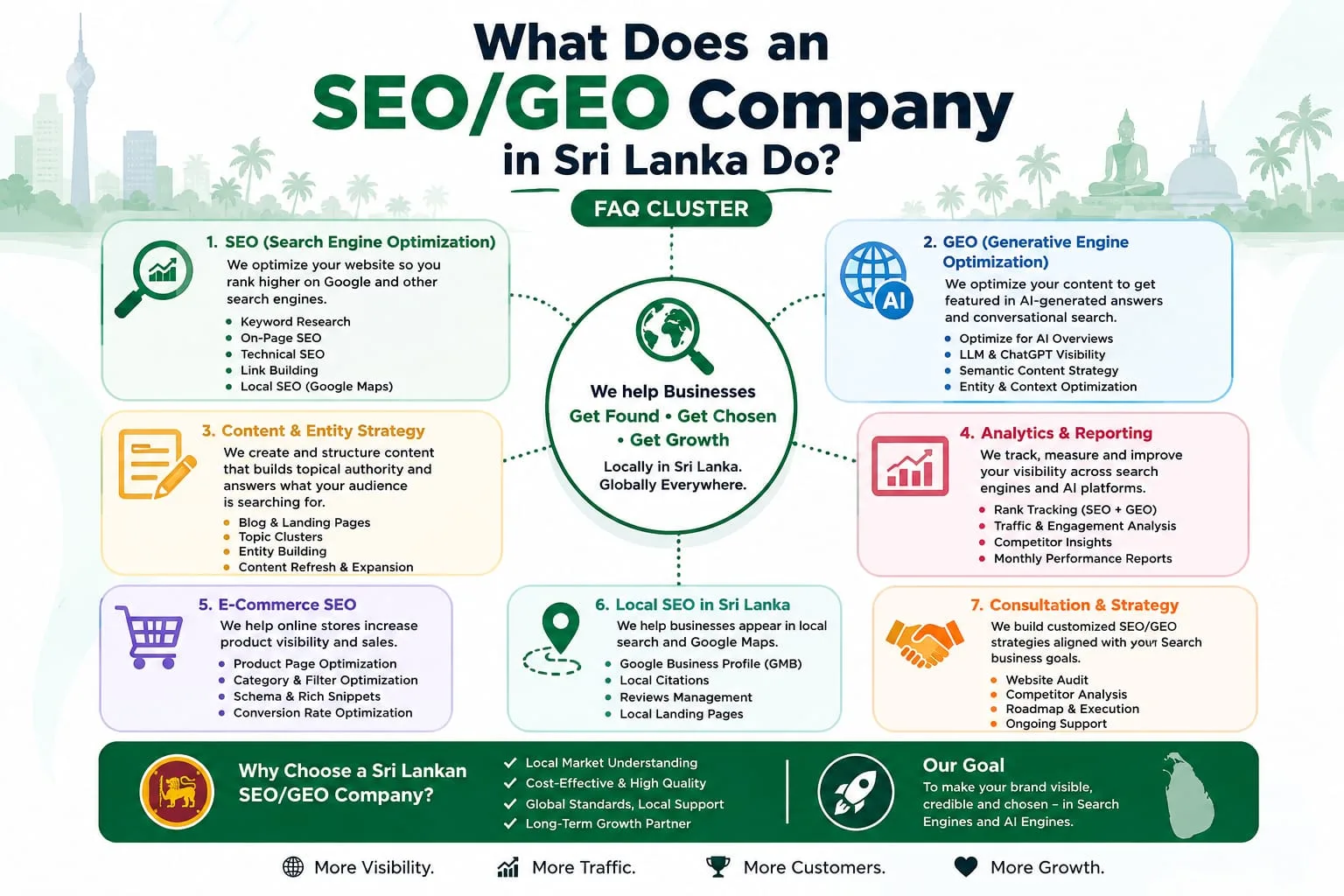
More international businesses are turning to SEO/GEO companies based in Sri Lanka — drawn by strong English-language content teams, competitive pricing compared to US, UK, or Australian agencies, and workable time-zone overlap with North America, Europe, and Asia-Pacific markets. But most business owners still don’t know what these companies actually do day to day, or how the job has changed now that people are asking ChatGPT, Gemini, and Perplexity for recommendations instead of typing into Google.
This FAQ cluster breaks down what an SEO/GEO company in Sri Lanka actually does for its international clients, why the “GEO” part matters now, and how to tell a real service provider from someone reselling a template.
SEO (Search Engine Optimization) is the practice of making a website easier for Google and other search engines to find, understand, and rank highly for relevant searches. For an international client, that usually means optimizing a business’s website so that when someone in their target market — New York, London, Toronto, Sydney, or wherever their customers are — searches for a service, that business shows up on the first page instead of the fifth, regardless of where the agency doing the work is physically based.
SEO work typically covers three broad areas:
A competent SEO company in Sri Lanka handles all three, not just one.
GEO stands for Generative Engine Optimization — the practice of optimizing a brand’s online presence so that AI systems like ChatGPT, Google’s AI Overviews, Gemini, Claude, and Perplexity mention, cite, or recommend that brand when users ask questions.
This is a genuinely different discipline from traditional SEO, even though the two overlap. Traditional SEO optimizes for a ranking algorithm that returns a list of ten blue links. GEO optimizes for a language model that reads across many sources, synthesizes an answer, and either cites your brand by name or leaves it out entirely. There’s no “position #3” in an AI answer — you’re either part of the synthesized response or you’re invisible.
This shift matters more in 2026 than it did even a year ago. A growing share of research, comparison shopping, and “best of” queries now happen inside AI chat interfaces rather than traditional search bars. A business that ranks well on Google but has no presence in how AI models describe its industry is increasingly leaving visibility on the table.
Most legitimate agencies structure their work around a few core deliverables:
Before any optimization starts, the agency crawls the client’s website looking for blockers — broken indexing rules, missing sitemaps, slow load times, duplicate content, and mobile usability issues. It’s common to find a critical, easily-missed issue here (a noindex tag left on from development, for example) that’s been quietly preventing an entire site from being crawled by search engines for months.
This identifies what people are actually searching for — both in traditional search boxes and in natural-language questions posed to AI assistants. GEO research differs from SEO keyword research because it maps question intent (“what’s the best GEO agency for a small business in my industry”) rather than short keyword strings (“GEO agency Sri Lanka”), and it’s built around the client’s target market rather than the agency’s home market.
This is where SEO and GEO diverge most visibly. SEO content is written to satisfy search algorithms and human readers scanning for information. GEO content is structured so language models can extract, quote, and cite it cleanly — clear headers, direct answers near the top of sections, FAQ formatting (like this article), and factual, well-sourced claims that models trust enough to repeat.
A serious GEO provider doesn’t just publish content and hope. They track brand mentions across AI platforms using metrics like citation frequency, answer coverage rate, and sentiment — essentially the GEO equivalent of rank tracking.
Agencies map how a client’s competitors are being described, cited, or recommended by AI systems, and identify visibility gaps — categories or questions where competitors get mentioned and the client doesn’t.
For both SEO and GEO, third-party mentions matter. AI models weigh how often and how consistently a brand is described across the web, not just what the brand says about itself. This means directory listings, press mentions, partner site links, and consistent brand descriptions across platforms all feed into both disciplines.
For clients with a physical location or region-specific offering — clinics, retail, service providers — this includes Google Business Profile optimization, local citation building, and location-specific content so the business appears in “near me” searches and local map packs in its own target country. For clients operating across several countries, this also covers hreflang tagging, currency and language localization, and country-specific keyword research, so the right content reaches the right market.
Because the two produce different, only partially overlapping results. A business can rank #1 on Google for its category in its target market and still be completely absent when someone asks an AI assistant, “who are the best options for X?” AI models don’t simply mirror Google’s rankings — they weigh factors like how clearly a brand’s offerings are described in structured, factual language across multiple independent sources, how recently that information was published, and how consistent the brand’s description is site to site.
For B2B service companies especially — SaaS providers, marketing consultancies, professional services firms — a growing share of prospective clients are using AI tools to shortlist vendors before ever visiting a website, regardless of which country the client or the agency is in. If a brand isn’t optimized to be part of that shortlist, it’s losing deals it never even knew existed.
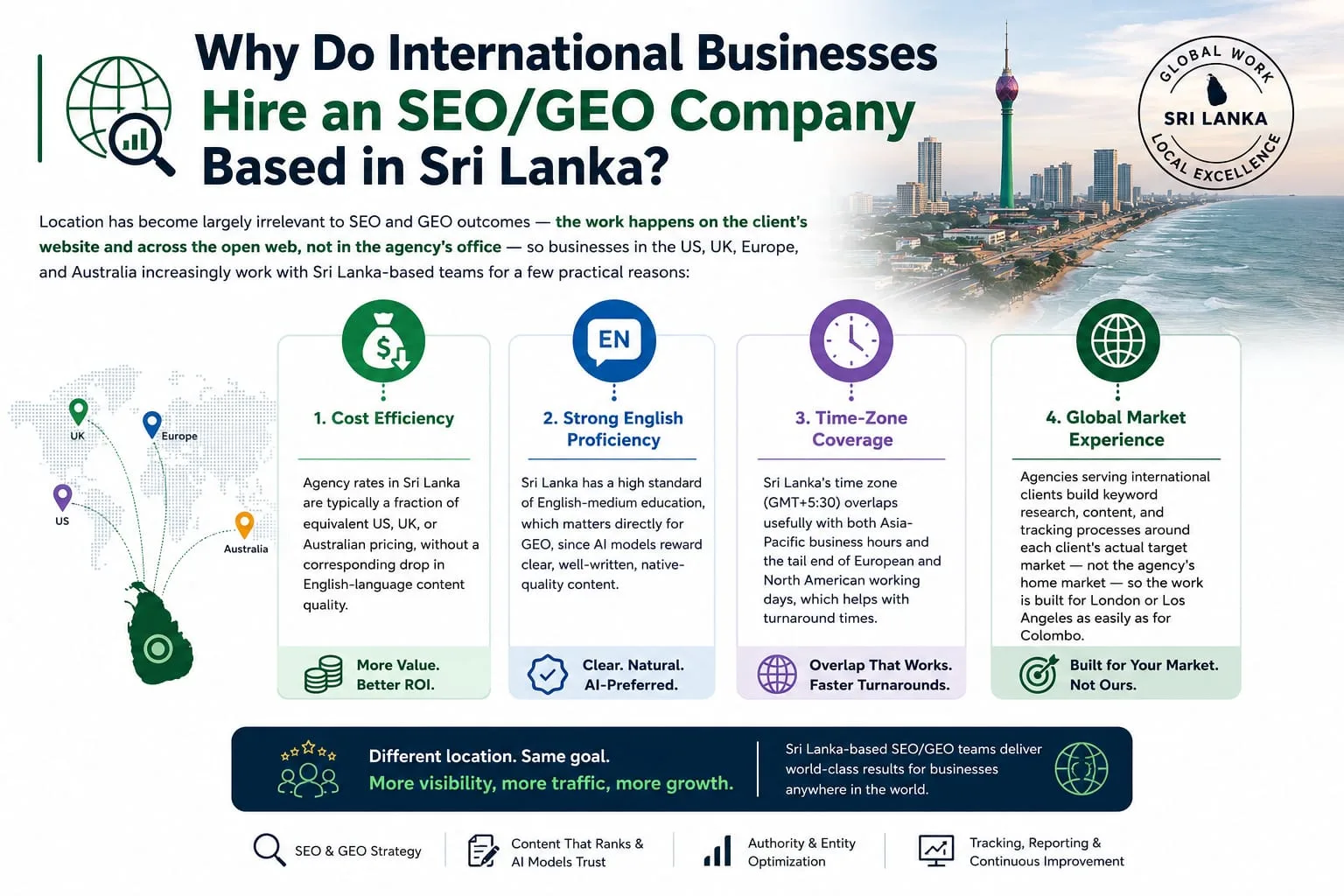
Location has become largely irrelevant to SEO and GEO outcomes — the work happens on the client’s website and across the open web, not in the agency’s office — so businesses in the US, UK, Europe, and Australia increasingly work with Sri Lanka-based teams for a few practical reasons:
Regular blog content is often written to be engaging, to build narrative, and to keep a reader scrolling. GEO content prioritizes different things:
This doesn’t mean GEO content has to be dry. It means the structure has to serve machine readability first, with good writing layered on top — which is exactly what this article is demonstrating.
Because GEO is a newer discipline, agencies use a mix of custom and emerging metrics. Common ones include:
These are tracked by repeatedly prompting AI systems with realistic customer questions and logging whether, how, and how favorably the brand appears — a manual-feeling but increasingly standardized process as more tooling emerges around it.
This is one of the most consistently misunderstood parts of the industry, in Sri Lanka and everywhere else. Traditional SEO in competitive niches — especially finance, health, and B2B services — realistically takes 6–12 months to produce meaningful organic traffic gains, even with strong execution. Anyone promising first-page rankings in a few weeks is either targeting extremely low-competition keywords or overselling.
GEO timelines are less predictable simply because the field is newer and AI platforms update their retrieval and citation behavior frequently. Some businesses see citation improvements within weeks of publishing well-structured content, particularly for narrower, less-contested queries; broader category visibility takes longer and requires sustained content and authority-building work.
A few practical checks:
An SEO/GEO company in Sri Lanka should be doing two related but distinct jobs: making a website easy for search engines to rank, and making a brand easy for AI systems to find, understand, and recommend. The first discipline is mature and well understood. The second is still forming its best practices in real time — which means the businesses that invest in it early, with agencies that actually track and measure AI visibility rather than just claiming to, have a real first-mover advantage in how their category gets described by the tools an increasing number of customers now trust to do their research for them.
At Enliven Designers, we’re a Sri Lanka-based agency built for international clients — pairing traditional SEO with GEO tracking and content built to be cited, not just ranked, wherever your customers actually are.
Our SEO/GEO Services Include:
Contact Enliven Designers today to get a technical audit and see where your brand stands with both search engines and AI assistants.
1. What’s the difference between an SEO company and a GEO company?
Increasingly, nothing — the same agency handles both, since GEO builds on the technical and content foundations SEO already requires. Standalone “GEO-only” providers are rare and often lack the technical SEO base GEO depends on.
2. Does GEO replace SEO?
No. GEO is additive. AI models still pull from indexed, crawlable web content, so a weak SEO foundation limits GEO results too.
3. Can a small or mid-sized business afford GEO?
Yes. GEO work reuses much of the same content and technical infrastructure as SEO, so it’s typically an incremental addition to an existing SEO budget rather than a separate large spend.
4. Does it matter that the agency is based in Sri Lanka if my customers are in the US or UK?
No. SEO and GEO work is executed against your website and your target market’s search behavior, not the agency’s location. Sri Lanka-based agencies working with international clients build their keyword research, content, and AI-visibility tracking entirely around the client’s actual market.
5. How do I check if my brand is already showing up in AI answers?
Ask ChatGPT, Gemini, or Perplexity the questions your customers would ask — “best [service] in [your city or country],” for example — and note whether your brand is mentioned, and how accurately.
6. Is GEO a passing trend?
The specific metrics and tools will keep evolving, but the underlying shift — more research happening inside AI assistants — is well established and growing, not temporary.

Get inspired! See how we've helped businesses like yours achieve success with our diverse portfolio.
Get inspired! See how we've helped businesses like yours achieve success with our diverse portfolio.
Copyright © 2025. All Rights Reserved.