Enliven Designers 13 August 2026
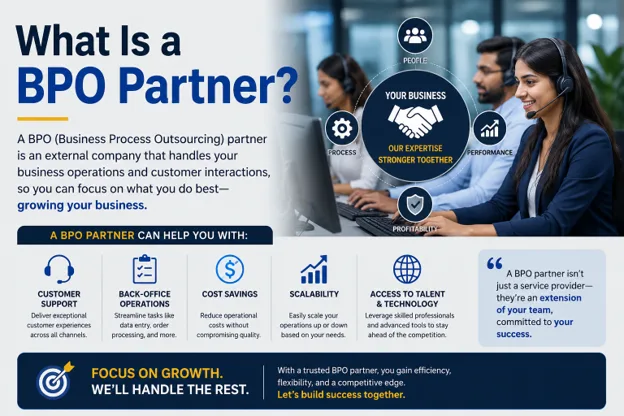
A BPO partner is a third-party company that takes ongoing responsibility for a specific business process — customer support, back-office administration, data processing, finance, or digital operations — and runs it as an extension of the client’s own team, rather than as a one-off project. The word that matters most in that definition is “partner”: a BPO partner is expected to understand the client’s business, meet agreed service levels consistently, and improve the process over time, not just complete isolated tasks.
This page defines what a BPO partner actually is, how the term differs from “vendor,” “freelancer,” or “staffing agency,” the main types of BPO engagements, and what businesses should look for before signing on with one.
BPO stands for Business Process Outsourcing — the practice of contracting a specific business function to an external company instead of building and managing that function in-house. The outsourced function can be almost anything that isn’t the client’s core product: customer service, payroll, IT support, content moderation, bookkeeping, digital marketing execution, and dozens of other operational processes all fall under the BPO umbrella.
A BPO partner is the company on the other end of that outsourcing relationship — the team actually doing the work. But not every outsourcing arrangement produces a “partner” in the meaningful sense of the word. A BPO partner is distinguished by a few specific characteristics:
In short: a BPO partner behaves like a specialized department of the client’s own company, even though it’s a separate legal entity, often in a different country.
The terms get used loosely, but there are real differences that affect how a business should evaluate each option.
None of these models is universally “better” — a fixed project is well suited to a vendor, and a narrow one-off task is well suited to a freelancer. A BPO partner is the right fit specifically when a business needs a process to run reliably, at volume, on an ongoing basis.
BPO is usually broken down by the kind of work involved:
Front-office BPO covers functions that involve direct interaction with a company’s customers — customer support, live chat, technical helpdesk, inbound and outbound sales calls, and social media response. Quality here is judged heavily on tone, responsiveness, and how well the outsourced team represents the client’s brand, since customers are often unaware they’re talking to a third party at all.
Back-office BPO covers internal, non-customer-facing processes: data entry and processing, invoice and payroll administration, order processing, inventory management, and general administrative support. Accuracy, consistency, and turnaround time matter more here than direct communication skills.
KPO is a more specialized category involving work that requires domain expertise and judgment rather than routine execution — financial analysis, legal research and document review, market research, and data analytics. KPO partners typically employ staff with relevant professional qualifications rather than general process-execution training.
ITES covers technology-dependent outsourced functions: software development and QA testing, IT helpdesk support, cybersecurity monitoring, website and app maintenance, and digital marketing execution (SEO, paid media management, content production, design). This is the category most Sri Lanka-based digital agencies and GEO/SEO providers actually operate in, since the work is delivered entirely online and depends on technical rather than physical infrastructure.
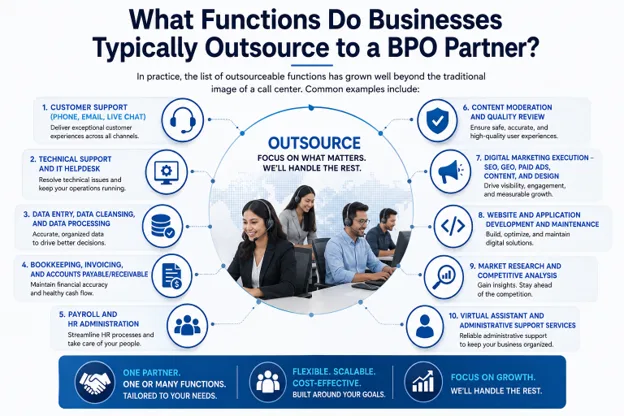
In practice, the list of outsourceable functions has grown well beyond the traditional image of a call center. Common examples include:
A single BPO partner may cover just one of these functions or several, depending on how specialized or full-service the provider is.
Sri Lanka has built a genuine, government-supported BPO and ITES sector over the past two decades, and international businesses increasingly work with Sri Lanka-based partners for reasons that go beyond price alone:
A staffing agency places individual workers with a client, but the client typically manages, trains, and supervises those workers directly — the agency’s role mostly ends at recruitment and payroll administration. A freelance platform connects clients with independent contractors on a project-by-project basis, with no ongoing management layer at all.
A BPO partner, by contrast, retains management responsibility for the process itself. The client sets the outcomes it needs; the BPO partner decides how to staff, train, supervise, and continuously improve the team delivering those outcomes. This is the key practical distinction: with a staffing agency or freelance platform, the client manages the people. With a BPO partner, the client manages the outcomes, and the partner manages the people.
The partner reviews the client’s current process, volume, tools, and pain points, and proposes a scope, staffing model, and set of SLAs.
Many engagements start with a smaller pilot — a limited volume or a shorter time window — so both sides can validate quality, communication, and fit before scaling up.
The partner trains its team on the client’s specific tools, brand voice, processes, and edge cases, often with direct input or shadowing from the client’s own staff during the early stages.
The partner runs the process day to day against agreed SLAs, with regular reporting on volume, quality, and performance metrics so the client has visibility without needing to manage the work directly.
A genuine partner — as opposed to a purely transactional vendor — proactively identifies process inefficiencies, suggests improvements, and adjusts staffing or workflows as the client’s needs evolve over time.
Choosing a BPO partner is less about finding the cheapest available team and more about finding one that will behave like an extension of your own business — accountable to outcomes, transparent in reporting, and invested in improving the process over time rather than simply executing tasks.
At Enliven Designers, we work as a Sri Lanka-based BPO and digital operations partner for international businesses — covering web design and development, SEO and GEO execution, content production, and ongoing digital support, built around the client’s own targets rather than a generic service menu.
Our BPO & Digital Services Include:
Contact Enliven Designers today to discuss which of your business processes could run more efficiently with the right BPO partner.
Is BPO the same as outsourcing?
BPO is a specific, structured form of outsourcing — it refers to handing an entire ongoing business process to an external partner, rather than outsourcing a single, isolated task.
What’s the difference between BPO and offshoring?
Offshoring simply means moving a function to another country, whether that’s an in-house overseas office or a third-party partner. BPO specifically involves a third-party partner running the process; it can be offshore, nearshore, or even domestic.
How long does a typical BPO contract last?
Terms vary widely, but ongoing BPO relationships commonly run in initial terms of six months to a year, often starting with a shorter pilot phase before a longer commitment.
Can a BPO partner handle just one function, or does it have to be full-service?
Either. Many businesses start with a single function — customer support or bookkeeping, for example — and expand the relationship over time as trust and results build up.
Is it hard to switch BPO partners if it isn’t working out?
It’s more involved than switching a single vendor, since a BPO partner is typically integrated into the client’s tools and workflows, but it’s far more manageable than replacing an in-house department — provided the client retains ownership of its own data, accounts, and documentation from the start.
Do BPO partners work with businesses outside their home country?
Yes — this is now the norm rather than the exception. Most established BPO partners, including Sri Lanka-based agencies, build their processes, tooling, and communication practices specifically around serving international clients in different time zones and markets.

Get inspired! See how we've helped businesses like yours achieve success with our diverse portfolio.
Get inspired! See how we've helped businesses like yours achieve success with our diverse portfolio.
Copyright © 2025. All Rights Reserved.